A Lifehouse Design is being trialled in Stroud, UK, as one approach for building togetherness, resilience, and power. It includes democratic decision-making, Lifehouses, and mutual aid networks operating at varying scales and levels of complexity. However, Lifehouse is not an attempt to reproduce any single model or vision. Context matters. A solution that works in one neighbourhood may not fit another. Instead, we aim to design pathways for traction — practical, adaptable frameworks, trusting that the best solutions will emerge from the specific needs and relationships of each place.
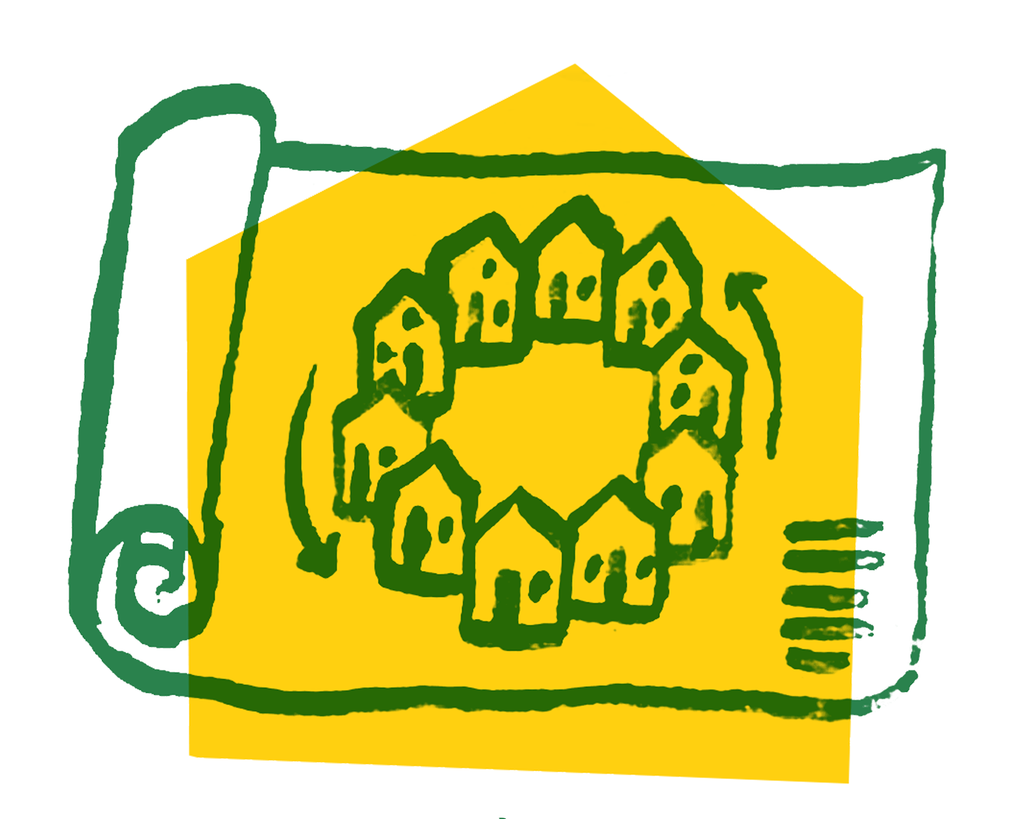
We are weaving together community organising, asset-based community development, mutual aid, participatory democracy, solidarity economics, and activism. Here we outline the design and in our Resources section you can access specific materials to support work in your own community.
New forms of democratic power are central to this vision including people’s assemblies, alongside alternative models such as ‘flatpack democracy‘ or community councils, depending on local preferences. As crises worsen and public services weaken, communities will need these foundations to respond effectively, fairly, and legitimately.
We propose a layered system with Homes linked to Streets, Streets to Neighbourhoods, and Neighbourhoods to Wards — building, where they exist, on what communities already have: residents’ associations, parish councils, neighbourhood forums, and the assemblies some places already run. At every level, decisions would be made democratically; we think of this suite of deliberative spaces as a ‘participatory commons’. Assemblies would be supported by Implementation Networks and an Anchor Lifehouse, which help put decisions into practice.
This is deep and wide-ranging work, engaging across the local ecosystem and linking mutually supportive responses to the challenges we face. It is ambitious, and we are still learning what it asks of us — probably the work of a lifetime, with fruits that many of us may never see. We lay the groundwork nonetheless.
Our connection is strongest at the local level — neighbourhoods, streets, households — where agency over local infrastructure and response to local needs feel most real and within reach. From there, we hope to seed transformation from the grassroots up: linking households into wider participatory democracy, and letting togetherness, resilience and power grow — slowly, and with others — into something genuinely transformational.
The Lifehouse Design in More Detail – A Spectrum of Engagement
The design sets out foundations at home, street, neighbourhood, ward and area levels, and these communities could link with other similar communities through a process called federation. We imagine this as work of several years before the foundations are well laid and wider connections begin to form — and every place will move at its own pace.
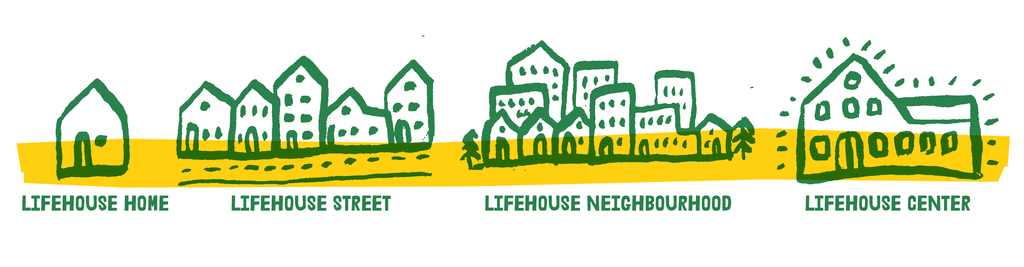
- Lifehouse Home for individual and household preparedness
- Lifehouse Streets for building resilience with immediate neighbours
- Lifehouse Neighbourhoods that connect multiple streets through shared resources and decision making.
- Lifehouse Centres are community spaces where activities take place that build togetherness, resilience and power. They might store supplies e.g. of food, water, medicine, generators, sandbags etc. They might provide shelter, e.g. acting as cooling and heating centres and host meetings and community processes, including assemblies.
The Lifehouse approach can cover a wider community area, bioregion and beyond. We envisage Lifehouse Communities will support each other in the Lifehouse Network.
The design supports engagement from the smallest unit – an individual and their home – to area-wide mobilisation. It represents a spectrum of activity, complexity, and scale. It is like a fractal pattern: the same principles apply whether you are preparing your home, organising your street, or running an area-wide assembly.
For example:
- A garden shed sharing food surplus operates on the same logic as…
- …a community pub serving as a hub for gathering, planning, and stockpiling, which mirrors…
- …a larger community centre coordinating regional relief and care.
Individual Engagement
An accessible first step is for a few people to come together and form a local Lifehouse community, i.e. a place to connect, and learn and share practices for building togetherness, resilience and power.
For those motivated to engage further, we support them in creating a Lifehouse Home. Even current government recommendations, involve planning for self-sufficiency in power, water, food, medicine, and warmth for three days.
Street-level Organising
We are looking for individuals who might be willing to start organising on their street. We are calling this organising role a ‘Lifehouse Keeper’. It involves:
- Leafleting, posting, and engaging residents in dialogue
- Creating or strengthening mutual aid networks on the street
- Signposting to local stakeholders (e.g. food groups and parish councils)
- Supporting decision-making processes
- Supporting community resilience planning, resource building, and scenario planning
Scaling and Systematising
Outline of Lifehouse:
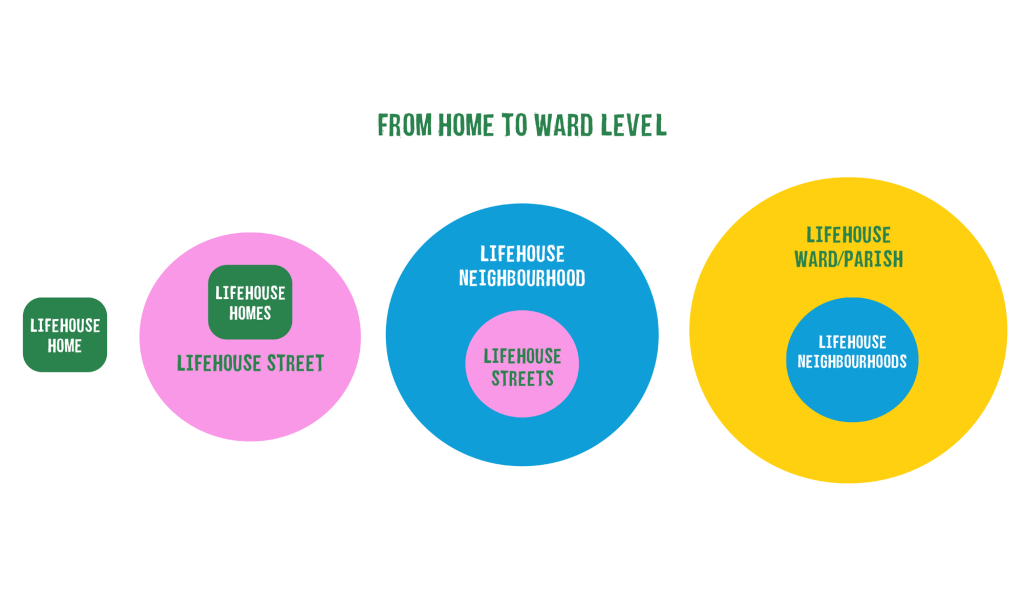
1. Lifehouse Home
Preparing practically and psychologically for the ‘long emergency’ at an individual level, in each home. The more Lifehouse Homes there are, the less strain on communal systems during disruptions, leaving more supplies available for those unable to stockpile, many are already struggling to afford the basics. A Lifehouse Home can also become a Lifehouse for others in need.
2. Lifehouse Street
Focuses on social connection, mutual aid networks, and light-touch collaboration (e.g., bulk-buying food, playdays on closed roads).
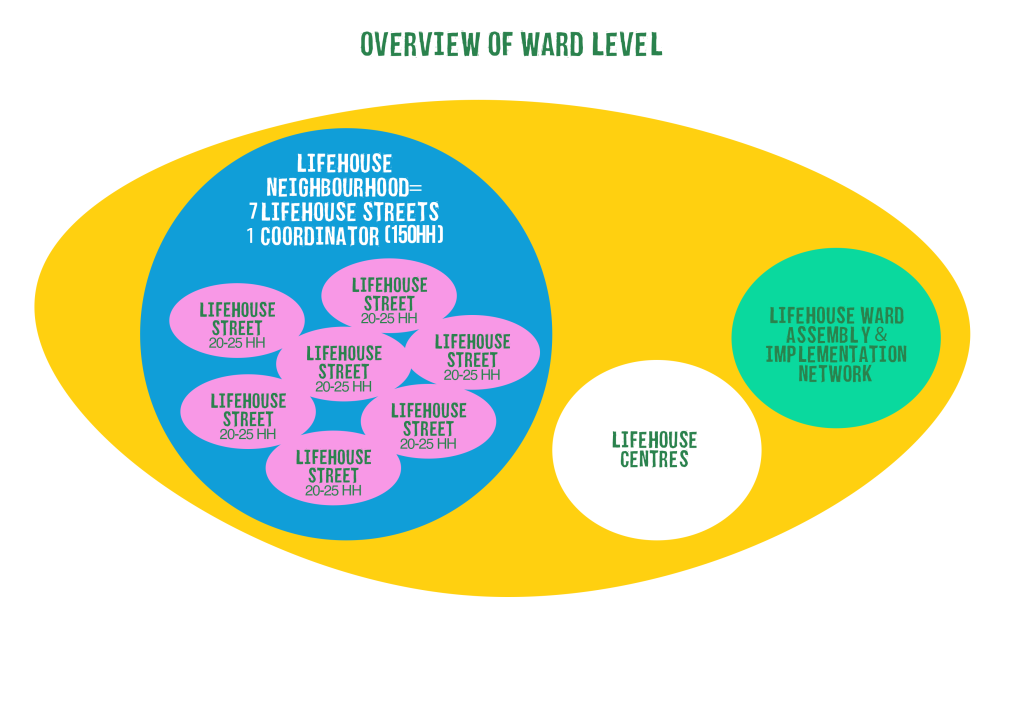
- Scale: roughly 20–25 households — a guide rather than a rule; what matters is a scale at which people can genuinely get to know each other. Every street will find its own size.
- Coordination: Manageable for one or two organisers (Lifehouse Keepers)
- Benefit: Small enough to foster genuine familiarity and ease of cooperation
3. Lifehouse Neighbourhood
Coordinated by one or more Lifehouse Keepers, this level moves into formal organising, connecting multiple Lifehouse Streets and working toward Ward-level initiatives.
- Scale: Perhaps five to ten streets, depending on the area — enough to share resources, few enough to stay personal..
4. Ward-level
Lifehouse Neighbourhoods feed into Ward-level structures — a ward’s worth of households, numbers varying from place to place. This level involves:
- Working towards Ward / Parish People’s Assemblies (where anyone can come) for collective decision-making
- Facilitating Lifehouse Centres, which are self-organised hubs capable of meeting resilience needs for longer periods and greater numbers of people
5. Area Level
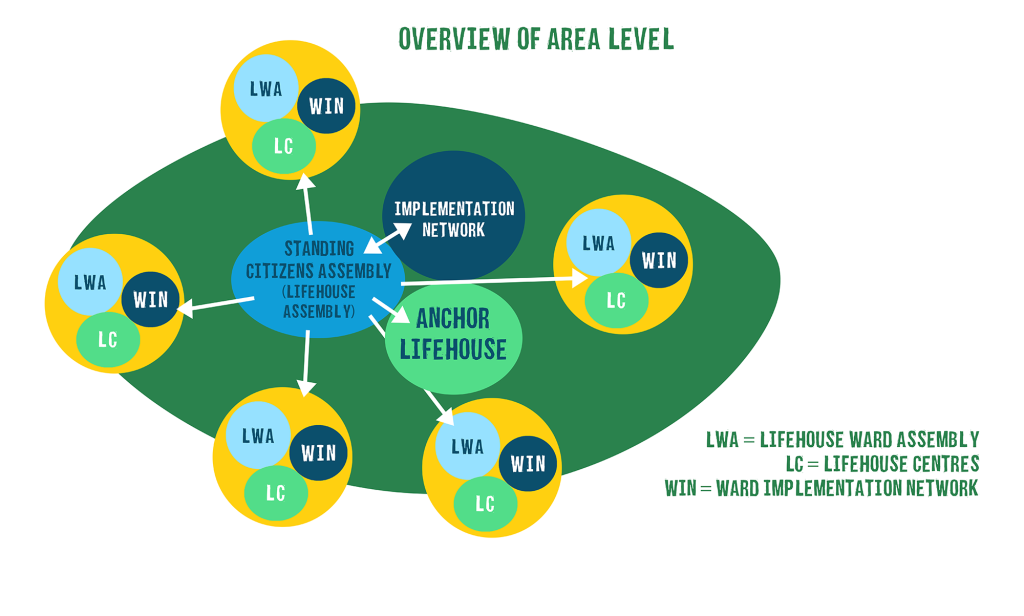
Covering an area of many thousands of households, this level features:
- A standing Citizens’ Assembly (‘sortition’- based) – this is the Lifehouse Assembly
- An ‘Implementation Network’ of local partners with the capacity to execute assembly decisions
- An Anchor Lifehouse with the capacity to meet needs for larger populations over extended periods, connecting with other Anchors across wider geographical areas to deepen resilience through resource sharing
Structure and Phasing
The Lifehouse Design toggles between home, street, neighbourhood, ward, and area levels. Levels are defined by natural and existing boundaries. One level can be a sole focus, or work can happen in parallel with levels interlinking and supporting each other. Overall coordination is supported by working groups organised through “sociocratic” principles.
We imagine three core phases, each with two broad sub-phases:
- Start up: groundwork to get going, expanding and preparing
- Implementation: building foundations, delivering different elements
- Sustaining, maintaining, growing: debriefing and learning, iterating and continuing
As the project develops, it builds confidence, agency, and power in decision-making spaces at the neighbourhood and area levels. If statutory authorities ever become unable, unwilling or authoritarian, these structures could, in time, have the potential to step in, even functioning in their place.
Examples of potential Assembly decisions are:
- Monthly street closures for children’s play
- Bringing specific plots of land into community use (including redundant buildings)
- Ensuring recognition of the ‘rights of nature’ in local development decisions
- Preparing and implementing area-wide plans for food or water shortages
These examples illustrate the spectrum: from immediate quality-of-life improvements, to claiming agency over assets, to reframing priorities, and finally to building robust crisis-response capacity.